Flat Tire Change in Lewisville, TX
Your spare fitted and torqued properly at the roadside. No spare, or nothing left of the sidewall, and it becomes a short tow to a tire shop instead.
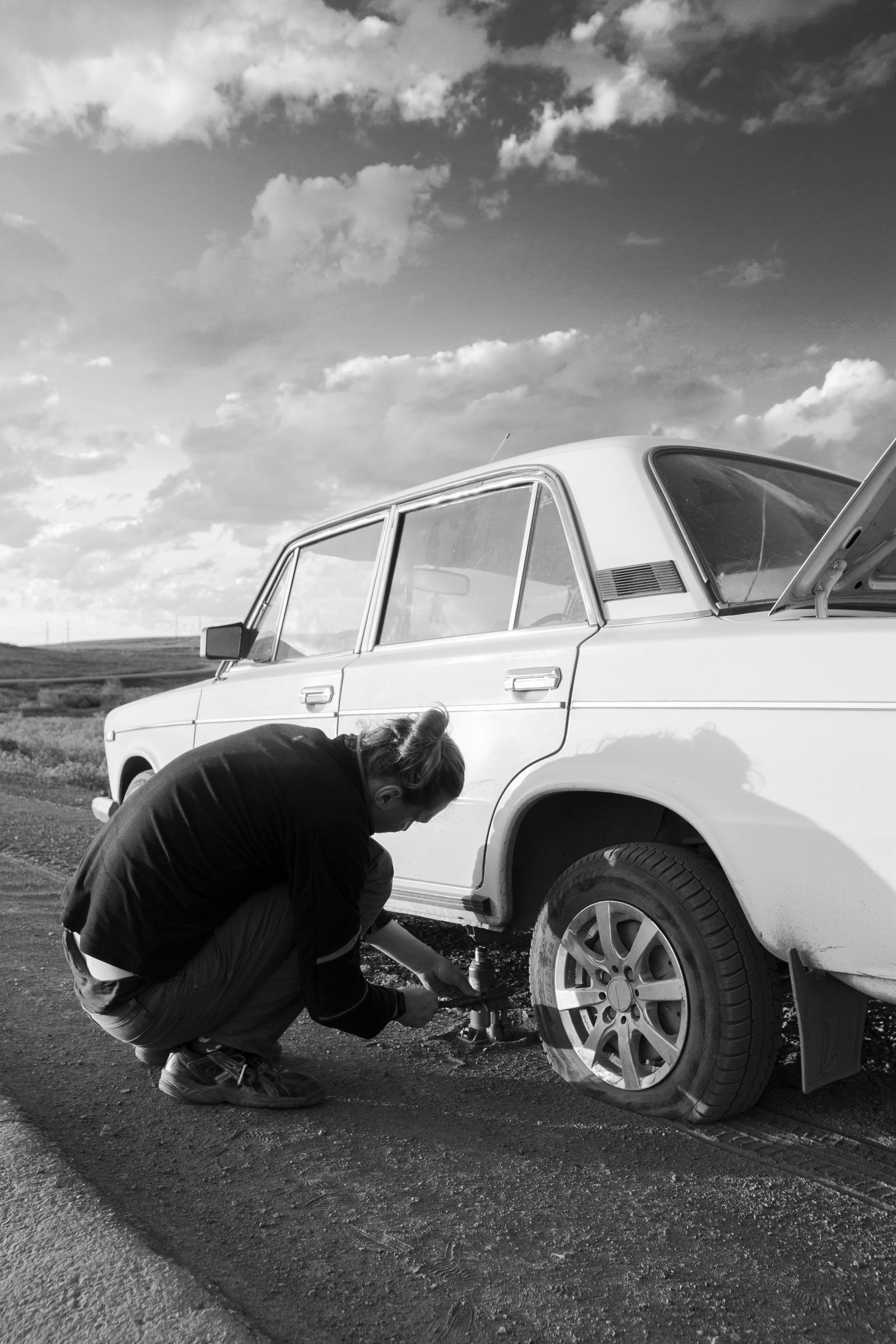
Changing it where it is safe to change it
Flat tire change in Lewisville, TX sounds like the simplest call on this site, and on a quiet residential street it is. The complication is where flats actually happen, which is on the Sam Rayburn Tollway and on I-35E, and neither is a place to be kneeling beside a wheel.
A roadside change is a jack on stable ground, wheel chocks, the car in park with the brake on, and lug nuts torqued properly rather than run up with a rattle gun. On a narrow shoulder next to traffic doing seventy, none of that is safe, and the right call is often to load the car and change it somewhere else.
What to do the moment it goes
- Do not brake hard or jerk the wheel. A blowout pulls the car toward the flat side. Hold it straight, ease off the throttle and let the speed fall away.
- Aim for somewhere flat and wide. An exit ramp, a frontage road or a parking lot beats a shoulder every time. A short distance on a ruined tire is worth it to reach a safe spot.
- Hazards on before you stop. Warn the traffic behind you early.
- Get out on the side away from traffic. If the flat is on the traffic side and the shoulder is narrow, do not attempt anything. Stay in the car and wait.
- Never jack a car on a slope or soft ground. A jack that slips under a loaded car is how people get seriously hurt.
Why so many Lewisville flats end in a tow
Two reasons, and both are local.
The first is the Sam Rayburn Tollway. Flats there happen at seventy miles an hour with long gaps between exits, so a driver keeps going to reach somewhere safe. By the time the car stops, the sidewall has been run flat and destroyed, and quite often the wheel rim is damaged too. There is nothing to fit a spare to the problem, so it becomes a flatbed to a tire shop.
The second is that new cars often carry no spare. Manufacturers save weight by supplying a sealant kit and a small compressor instead. That combination handles a nail in the tread and is useless against a torn sidewall or a blowout. Plenty of drivers do not know which they have until they open the trunk on a shoulder.
Worth adding a third: I-35E through the construction zone throws up debris. Rebuild work means metal, bolts and broken concrete on the road surface, and that stretch punctures more tires than anywhere else in the city.
Check these three things this week
Five minutes in your own driveway saves an hour on a shoulder.
- Do you have a spare? Lift the trunk floor and look. If it is a sealant kit, check the sealant expiry date, because it does expire.
- Is it inflated? Space saver spares sit for years and lose pressure. A flat spare is the same as no spare.
- Do you have the tools and the wheel lock key? Jack, wrench and, if your wheels have locking nuts, the key adapter. That adapter is often in the glovebox and often missing, and without it the wheel is not coming off for anyone.
What happens on the call
- The spot gets assessed. If the ground or the traffic makes a change unsafe, the car moves first and gets changed somewhere sensible.
- Proper lifting points. Modern unibody cars have specific reinforced points. Jacking elsewhere bends a sill and it is an expensive mistake.
- Chocks and a stable base. Especially on any kind of slope, which covers most of the lake-side roads in Highland Village.
- Torqued, not rattled. Nuts tightened in a star pattern to spec so the wheel seats evenly.
- An honest look at the flat. Whether it is repairable or scrap, and whether the wheel itself survived.
Once the spare is on, drive gently and get to a tire shop. If the sidewall is torn, the wheel is bent or there is no usable spare, the sensible answer is a short tow rather than trying to make something work.
Questions about flat tire change in Lewisville
What if I do not have a spare?
A lot of cars sold in the last ten years do not come with one. Instead there is a sealant kit and a compressor, which works on a small puncture and does nothing for a torn sidewall. No spare and a destroyed tire means a tow to a tire shop, so it is worth checking your trunk now rather than finding out on a shoulder.
How far can I drive on a space saver spare?
The limits are printed on the tire itself and they are real: usually 50 miles per hour and about 70 miles total. It has a narrower tread and a different rolling diameter, so it affects braking, stability and on some cars the traction control. Treat it as a way to reach a tire shop, not as a tire.
Can you plug or patch it at the roadside?
Not reliably, and not safely on a sidewall. A tread puncture can sometimes be plugged as a temporary measure, but a proper repair means the tire comes off the wheel and gets patched from the inside where the damage can be inspected. Anything through the sidewall or the shoulder is not repairable at all.
The tire is fine but the lug nuts will not move. Can you help?
Usually yes. Overtightened lug nuts from an impact gun are extremely common and they defeat the little wrench that came with the car. A breaker bar and the right socket normally solve it. Locking wheel nuts without the key adapter are a different problem and often mean a tow.
Related help in Lewisville
- Emergency Towing Broken down, blocking a lane, or stopped somewhere you should not be. This is the call that moves first.
- Flatbed Towing All four wheels off the ground. The right call for all-wheel drive, low clearance, EVs and anything that cannot roll.
- Battery Jump Start A boost at the curb, plus an honest read on whether the battery will get you home or strand you again.
- Car Lockout Keys on the seat and the doors shut. Opened with wedge and reach tools, no broken glass.
Need a truck in Lewisville right now?
Tell us where you are, what you drive and what happened. That is enough to get the right truck moving.
Call 469-309-5877